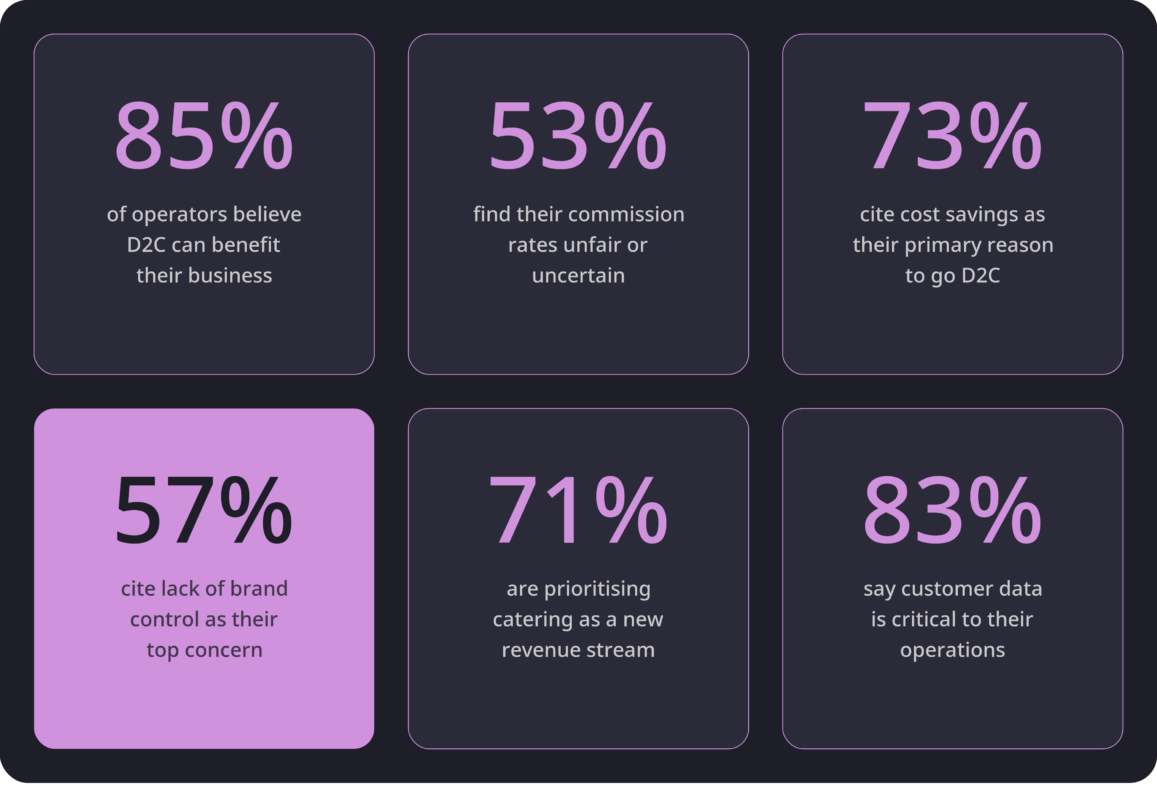
We surveyed 112 UK restaurant operators, from independent locals to established multi-site chains, on how they really feel about digital ordering in 2026. What came back is a clear picture of an industry at a turning point: frustrated with marketplace dependency, increasingly convinced by direct-to-consumer channels, and actively looking for a more resilient way to run their businesses. Here’s what the data says.
What Does the Data Actually Tell Us?
The headline finding is simple: the relationship between UK restaurants and third-party marketplaces is under real strain. Commission costs, brand control, and customer data ownership are the three fault lines, and all three are pushing operators towards direct ordering. Below, we break down the key findings in detail.
1. Over Half of Operators Don’t Trust Their Commission Rates
Commission fairness is the most visible flashpoint in the marketplace relationship. Our survey found that 53% of restaurant operators either believe their commission rates are unfair or are genuinely uncertain about whether they are, which in itself signals a breakdown in trust.
- 24% cite commission costs as a top operational concern
- 60% have already raised their marketplace prices to absorb rising costs
- 9% of businesses generate more than half their total revenue through marketplaces
When the majority of your partners question whether your pricing is fair, that’s not a billing issue. It’s a structural one. Operators who are most exposed are those using marketplaces as a primary revenue channel, where fee erosion compounds with every order.
2. Brand Control Is an Even Bigger Concern Than Fees
The most frequently cited issue in our survey wasn’t commission rates. It was brand control. 57% of operators flagged a lack of control over the customer experience as their primary concern when working with third-party platforms. For restaurants where the brand is everything, this matters enormously.
- Photography, descriptions, and presentation are largely dictated by the platform
- Post-order communication goes through the marketplace, not the restaurant
- Customer loyalty is built to the platform, not the brand
Operating through an intermediary means accepting that the experience your customer has isn’t fully yours. As consumer expectations around brand consistency grow, this is becoming harder to ignore.
3. 85% of Operators Believe D2C Can Benefit Their Business
Despite the pressures, the mood in the data is quietly optimistic, and it’s centred on direct-to-consumer channels. An overwhelming 85% of respondents said they believe a D2C channel can have a positive impact on their business. This isn’t a fringe view; it’s near-consensus across the sector.
- 24% already have a direct ordering channel in place
- 34% are actively considering adding one
- Only 13% are not considering D2C as part of their 2026 strategy
D2C channels, including your own website ordering, branded app, Google Business Profile, and social commerce, give operators something marketplaces cannot: ownership of the transaction, the data, the relationship, and the margin.
4. Cost Savings Are the Primary Driver for Going Direct
When we asked operators what’s motivating their interest in D2C, the answers were clear. 73% cited cost savings as the primary reason, as removing commission fees from the equation has an immediate and meaningful impact on profitability per order. 58% cited brand and customer experience control as the second key motivator.
- 73% motivated by cost savings from removing commissions
- 58% motivated by brand and customer experience control
- 30% motivated by access to customer data
That last figure is worth noting. Only 30% cited data as a key motivator for D2C, yet 83% of the same operators told us customer data is critical to their operations. The operators who connect those two facts and act on them will have a significant advantage.
5. Policy Changes Are Accelerating the Shift
The National Insurance and minimum wage changes of 2026 haven’t just squeezed margins. They’ve forced a rethink of how operators structure their entire business. When labour costs rise and revenue stays flat, the pressure to find higher-margin channels intensifies sharply.
- 63% are increasing menu prices to offset rising costs
- 44% are hiring fewer staff
- 42% are reducing employee hours
- 17% are investing in technology to manage the gap
For operators already paying 20 to 30% in marketplace commission, the maths of D2C becomes increasingly compelling as every other cost line rises. A shift in just a portion of orders to a direct channel can meaningfully improve margin without any further cuts.
6. Branded Apps Are the Next Frontier for Customer Loyalty
77% of operators told us they see real value in having their own branded ordering app, not just as a sales channel, but as a loyalty and retention tool. A branded app creates a direct line to your customer that no marketplace can disrupt or monetise on your behalf.
- Push notifications drive repeat orders without ad spend
- In-app loyalty programmes build habit and retention
- Customer data from every order stays with the operator, not the platform
Slerp gives operators their own fully branded mobile app and web store, allowing them to deliver a premium, direct ordering experience while retaining full control of the customer relationship and data.
7. Catering Is the Highest-Priority New Revenue Stream
71% of operators are prioritising catering as a new revenue stream for 2026. It’s easy to see why: large-format, high-value orders carry significantly better economics than individual consumer deliveries, and they’re largely invisible to marketplace platforms.
- Corporate and office catering buyers reorder regularly, often weekly
- Average order values are far higher than standard delivery orders
- Commission-free fulfilment makes the margin profile materially better
Slerp enables operators to offer catering online directly, with large-format orders managed through appropriate courier vehicles, automatically organised at checkout, without needing a separate logistics operation.
8. The Hybrid Model Is Where Most Operators Are Landing
This isn’t an either/or moment. The most common strategic direction emerging from the data is a hybrid model: maintain marketplace presence for discovery and reach, while building D2C channels for profitability, retention, and customer ownership. 46% of operators still rely primarily on marketplaces, but 23% have already adopted a direct ordering platform, and that number is growing.
- Use marketplaces for acquisition and new customer discovery
- Use D2C for retention, margin, and loyalty
- Rebalance over time as your direct channel grows
The operators building this dual infrastructure now are creating a more diversified and resilient revenue base, one that doesn’t depend on a single platform’s algorithm or pricing decisions.
9. Customer Data Is Underused and That’s a Risk
83% of operators told us customer data is critical to their business. But only 24% have someone internally responsible for it, and only 30% cite data ownership as a key reason to invest in D2C. There’s a significant gap between recognising the value of data and actually capturing and using it.
- Marketplace orders give you no customer data, as the platform owns the relationship
- Direct orders give you full visibility: who ordered, what, when, and how often
- That data powers retention campaigns, loyalty programmes, and re-engagement
Customer data collected through Slerp orders can be used within the Slerp CRM to build segments, create automations, and run targeted campaigns, turning every direct order into long-term marketing infrastructure.
10. Loyalty Infrastructure Is Still Lagging, But It Doesn’t Have to Be
Despite the widespread belief in D2C’s potential, loyalty infrastructure is still surprisingly underdeveloped across the sector. 35% of operators are still using pen and paper loyalty cards. 40% are constrained by their existing POS systems. And yet 49% of operators say point-based rewards are their preferred loyalty format, which is the exact model that a direct ordering platform makes simple to run.
- Paper loyalty cards create no useful data and are easy to lose
- POS-based loyalty is often siloed from ordering and hard to scale
- D2C loyalty connects ordering, data, and rewards in one place
Effective loyalty is one of the highest-ROI activities available to a restaurant. Every repeat order you earn costs far less than acquiring a new customer through paid channels or marketplace promotions, and it compounds over time as customer lifetime value grows.
What UK Hospitality’s Data Tells Us About 2026
The operators who will perform best in 2026 aren’t necessarily the biggest or the best-funded. They’re the ones who own their customer relationships and build the infrastructure to manage them. The research points clearly in one direction.
- Rebalance your channel mix and reduce marketplace dependency over time
- Build a D2C channel that captures customer data from day one
- Invest in branded loyalty that works across ordering and retention
- Add catering as a high-margin, low-competition revenue stream
- Use technology to maintain service quality as cost pressures mount
Slerp gives you the tools to do all of this commission-free, with direct ordering, a branded app, built-in CRM, loyalty programmes, discount codes, and customer data ownership from day one.
Want to see how it works for your business? Book a demo with Slerp today.
Frequently asked questions
What percentage of UK restaurants don't trust their marketplace commission rates?
53% of UK restaurant operators either believe their commission rates are unfair or are uncertain about whether they are, according to a 2026 Slerp survey of 112 operators. 24% cite commission costs as a top operational concern, and 60% have already raised their marketplace prices to absorb rising costs.
What is the biggest concern UK restaurants have with third-party delivery marketplaces?
Brand control, not commission. 57% of UK restaurant operators flagged a lack of control over the customer experience as their primary concern when working with third-party platforms. Photography, presentation, post-order communication, and customer loyalty all default to the marketplace rather than the brand.
How many UK restaurants believe direct-to-consumer ordering can benefit their business?
85% of UK restaurant operators believe a direct-to-consumer (D2C) channel can have a positive impact on their business. 24% already have a direct ordering channel in place, 34% are actively considering adding one, and only 13% are not considering D2C as part of their 2026 strategy.
What is driving UK restaurants to invest in direct ordering in 2026?
Cost savings are the primary driver — 73% of UK operators cite removing commission fees as the main motivation for going direct. 58% cite brand and customer experience control as the second key motivator. Only 30% cite customer data access, despite 83% saying customer data is critical to their operations.
How many UK restaurants want their own branded ordering app?
77% of UK restaurant operators see real value in having their own branded ordering app, both as a sales channel and as a loyalty and retention tool. Branded apps drive repeat orders through push notifications, host in-app loyalty programmes, and keep customer data with the operator rather than the platform.
What new revenue stream are UK restaurants prioritising in 2026?
Catering. 71% of UK restaurant operators are prioritising catering as a new revenue stream for 2026. Corporate and office catering buyers reorder regularly, average order values are far higher than standard delivery, and catering is largely invisible to marketplace platforms — making the margin profile materially better than third-party delivery.
How many UK restaurants still use paper loyalty cards?
35% of UK restaurant operators are still using pen-and-paper loyalty cards in 2026, and 40% are constrained by their existing POS systems. Yet 49% say point-based rewards are their preferred loyalty format — the exact model a direct ordering platform makes simple to run.
Should UK restaurants leave delivery marketplaces entirely?
No — most operators are landing on a hybrid model. 46% still rely primarily on marketplaces, 23% have already adopted a direct ordering platform. The emerging best practice is to use marketplaces for new customer acquisition and discovery, and use D2C for retention, margin, and loyalty — rebalancing over time as the direct channel grows.